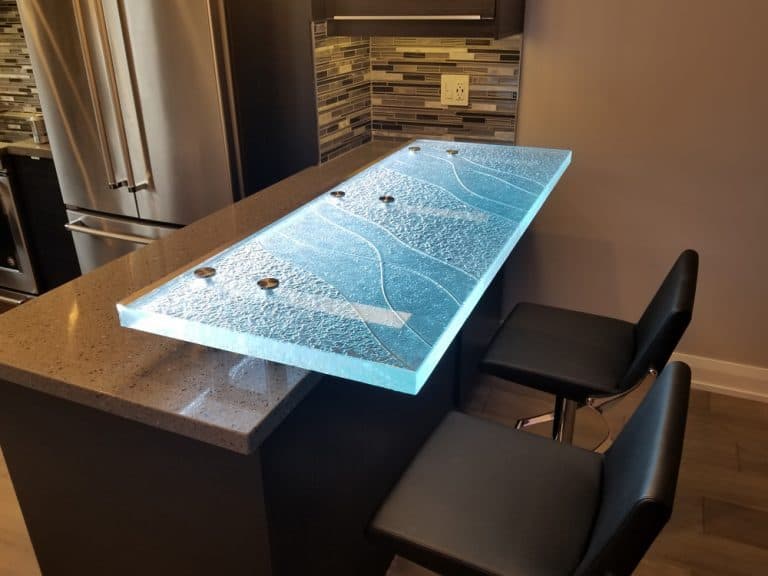
Even though glass countertops have been in the interior scene for decades, it’s still a controversial choice. There is simply too much misinformation circulating online regarding glass as a countertop material. People assume it’s not strong enough, not a good fit for kitchens, very expensive, and whatnot.
If you are considering getting a pristine glass countertop for your home, it’s important to clear out the myths that might become an obstacle in your decision-making process. So, if you are in, let’s get rolling.
Let’s Debunk Common Myths About Glass Countertops
Myth 1: Not Strong Enough
People assume glass is “fragile.” But the glass used to manufacture countertops is tempered and heat-treated, which is almost five times stronger than the untreated version.
As for durability, we can measure flexural strength. It’s a metric that indicates how much force a material can resist before bending or breaking.
| Countertop Material | Flexural Strength |
|---|---|
| Tempered Glass | 24,000-30,000 psi |
| Granite | 19,000- 28,000 psi |
| Marble | 9,000-14,000 psi |
| Quartz | 12,000-18,000 psi |
Nonetheless, glass works best if the load is equally distributed along its surface.
Myth 2: Costs A Lot!
The cost of glass countertops lies in the same price range as other popular materials. The price range per sq ft for marble or granite is $50 to $200. Tempered glass countertops cost $60 to $250 per sq ft. See? We can’t say it’s too expensive, given that glass is more customizable than other materials.
Myth 3: Not Meant For Busy Kitchens
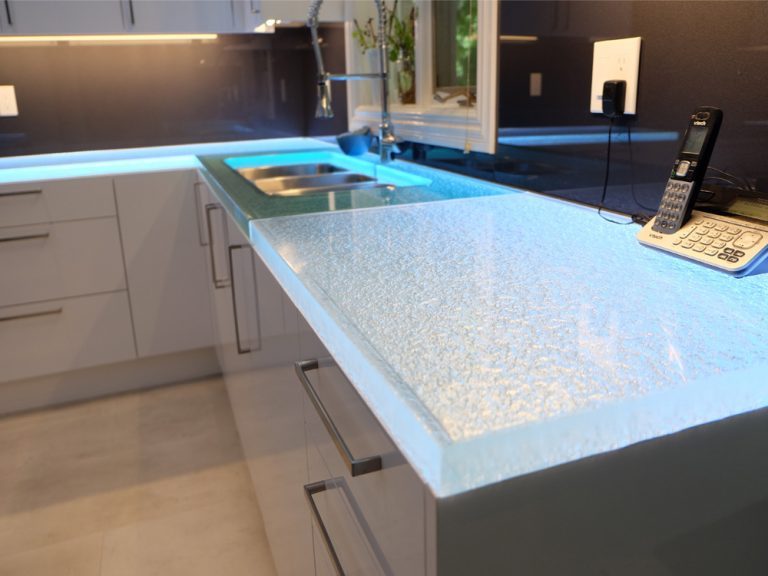
“Meant for busy kitchens” usually indicates whether the material is scratch-resistant or not. Busy kitchens tend to have lots of knife action. And, people have a misconception that glass countertops are merely decorative and can get scratched easily.
But on the Mohs scale (universally accepted scale to measure scratch resistance of a material), tempered glass stands at 6 (out of 10). It performs much better than marble, which gets only 3 on this scale.
Myth 4: Clean-Up Is A Nightmare
That’s an outright lie. Cleaning up a glass surface is the easiest thing ever. Glass, being non-porous, doesn’t let any moisture get trapped under the surface. So, you give it a gentle wipe and the stain is gone. For regular clean-up, you only need mild soap and water. No harsh chemicals are required.
Myth: 5: Looks Too Simple/ Not Meant For traditional Houses
Another misconception regarding glass countertops is that these are meant for “minimalist” homes with a neutral aesthetic. “Icy” glass countertops don’t really complement warm or cozy homes with wooden walls or floors.
For a traditional house, you can skip low-iron ultra-clear glass and go for the tinted options. Back painted glass countertops are also very common today. Colors like beige, taupe, or terracotta will complement a cozy aesthetic.
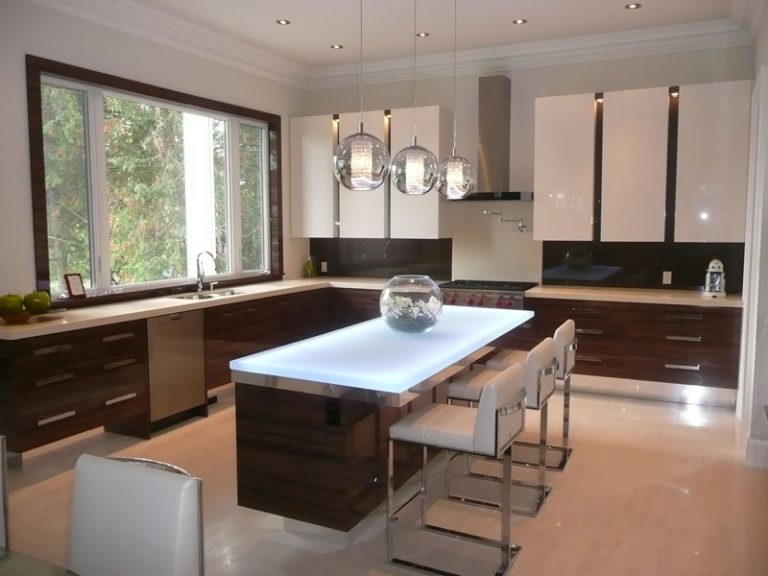
Reliable brands will even allow you to customize the glass texture and edge shape to further enhance its compatibility to whatever style you prefer.
Myth 6: Risk Of Sudden Shattering
Modern tempered glass almost never shatters suddenly. There’s a 0.1% to 0.3% probability that a flawless glass countertop with no NiS (Nickel-Sulfide) spots and a robust edge profile will shatter under usual circumstances. And, even if it breaks due to thermal shock or uneven stress, it is designed to crumble into small cubes, not sharp pieces. So, the risk of injuring yourself in case the unthinkable happens is very rare.
Myth 7: Too Heavy
Compared to other popular countertop materials like granite or marble, tempered glass is much lighter. Let’s assume a kitchen counter is 20 sq ft with a thickness of 1¼ inches. Here’s how much it will weigh.
| Countertop Material | Density (lb/ft^3) | Total Weight (lb) |
|---|---|---|
| Tempered Glass | 16.3 | 326 |
| Granite | 17.8 | 356 |
| Marble | 18.9 | 378 |
| Quartz | 17.3 | 346 |
Myth 8: Gets Yellow Or Discolored Over Time
Glass is the only countertop material that can guarantee a stable color throughout years of use. Its surface avoids oxidation or UV degradation. So, there’s no risk of getting yellow after some years.
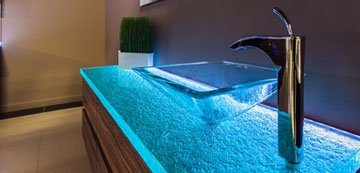
People assume glass loses its natural color because some old glass furniture used to have cheap adhesives around the edges. It’s the adhesive or sealant that discolors over time in contact with heat.
Myth 9: Can’t Withstand Heat
Tempered glass is much more heat-tolerant than regular glass. As it goes through a heat treatment process first, the final heat resistance of tempered glass ends up being close to that of granite, the classic kitchen countertop material.
| Countertop Material | Max Heat Resistance |
|---|---|
| Tempered Glass | 500°F |
| Granite | 480-530°F |
| Quartz | 350°F |
| Marble | 400°F |
The table proves that glass countertops are perfectly safe for even heavy use kitchens. As long as you use some trivets under hot pans directly out of the oven, you are good to go.
Bottom Line
It turns out tempered glass is scratch-resistant unless you plan on scratching the surface with steel scrapers. Also, its weight capacity is impressive unless you distribute the weight unevenly (putting all the weight near the edges). As long as you maintain these few rules, your glass countertop will remain the same for decades, just as the day you brought it home.