The average kitchen size for single-family homes is 150 to 175 sq ft. If we are talking about new apartments or condos in high-rise cities, the kitchen space gets reduced to 70 to 100 sq ft. That’s what we call a compact or small kitchen.
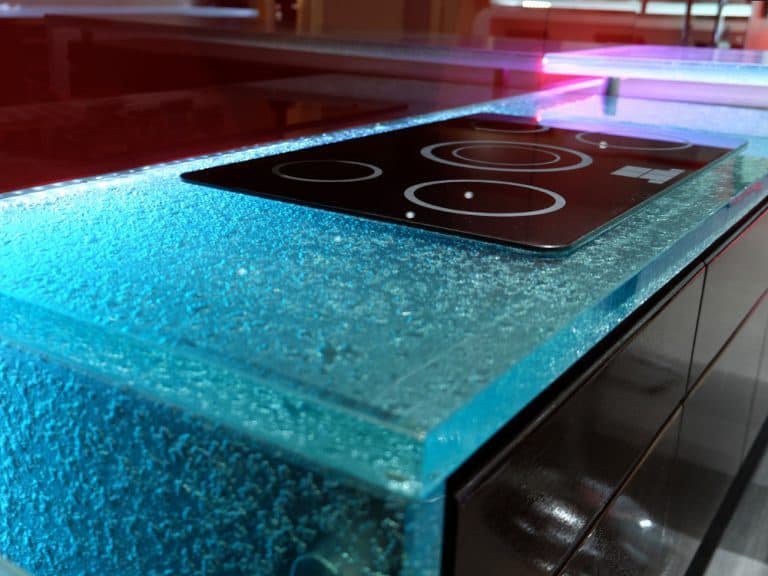
The space is limited, so you have to be very picky regarding the countertop. It should not just fit in your kitchen but also be able to make the space look more elongated. And, glass countertops fit the bill perfectly.
Sounds too good to be true, right? In this article, we explain why and how glass countertops are your kitchen’s best friend. So, stick with us if you are also stuck with a small kitchen.
What Makes A Countertop Small Kitchen-Friendly
High LRV/ Light Reflectance Value
LRV is a scale heavily used by professional interior designers to determine the right type of countertop for a specific room. As we are furnishing a small kitchen, the countertop material must have a high LRV.
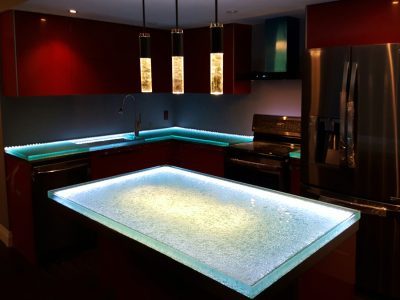
A higher percentage indicates more light bouncing off the counter, making the kitchen brighter than it actually is. That’s one of the biggest factors to aim for.
Visual Bulk
Next comes visual bulk or weight. We don’t mean the actual weight of the material, but the perceptive heaviness. For example, a half-inch-thick granite slab looks way heavier than glass. For a small kitchen, you want something to look “lighter,” unobtrusive, and airy.
Overall High Space Perception
Apart from the LRV rating and visual weight, other factors also play a big role in making a countertop the best fit for a smaller kitchen.
- Color
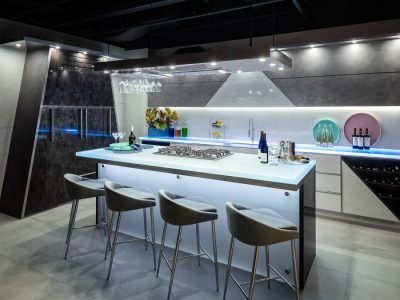
It’s a no-brainer that lighter colors work better in smaller spaces. Colors like white (85% LRV), off-white, and light gray reflect light the most. Just below them are soft pastels, soft sand, and warm beige tones with an LRV of 70%.
On the other hand, colors like dark green, navy, or black have stood lower on the LRV scale (below 50%), causing the room to look heavier and smaller.
- Edge Profile
A straight (90-degree turn) or square edge carries minimum visual weight. If you want a little more sophisticated look, a beveled edge (45-degree turn from upper surface) would be fine.
Other edges like ornate, ogee (S-shaped) or bullnose (rounded) appear heavier on naked eyes. These might be more expensive and decorative, but not the best fit for a small kitchen.
Why Glass Countertops Are Perfect For Small Kitchens
Now that you have a clear idea of what you should be looking for, let’s explain why glass countertops are best for a small kitchen. We will do two tests: the LRV test, as well as an overall space perception test that takes into account factors like visual weight, seamlessness, and light light-enhancing capacity.
LRV Test- Glass Countertops vs Others
| Countertop Materials | LRV (Light Reflectance Value) | Remark | Small Kitchen Compatibility |
|---|---|---|---|
| Tempered Glass | ~80%-90% | Bounces light around the room | Very high |
| Marble | ~70% | White or beige colored marbles are highly reflective. Other colors can be dark. | high |
| Quartz (engineered stone) | ~40% | Gives a muted tone | medium |
| Butcher Block | ~20% | Gives a warm and cozy feel. But absorbs light. | Low |
| Granite | ~10% | Very dark and looks heavy on the eyes. | Very low |
Space Perception Test- Glass Countertops vs Others
| Materials | Visual Weight (out of 10) | Space Perception (out of 10) |
|---|---|---|
| Tempered Glass | 2 | 9 |
| Granite | 8 | 4 |
| Quartz | 5 | 7 |
| Butcher Block | 6 | 5 |
The lower the visual heaviness of a material, the higher the space perception it will provide. In that sense, granite performs the worst with a visual weight of almost 8. It will make your small kitchen look even more congested.
Tempered glass is on the other end of the spectrum with a visual weight of only 2. Among all these popular countertop materials, tempered glass stands out as the best fit for a small kitchen, no doubt.
Tips To Make Your Glass Countertop Look Even More Spacious
Okay, so we are sure about tempered glass. But is it all rainbows? Obviously not. There are certain things to watch out for after getting your glass countertop.
1. Keep It Clutter-free
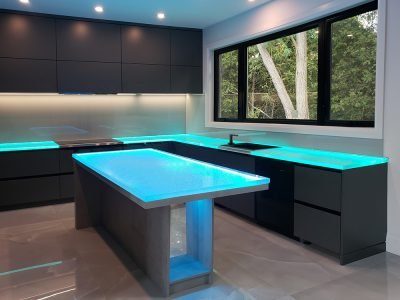
Remember, we chose glass because of its high light reflectance value. But to properly reflect light all over the room, you need to keep the surface clutter-free. Minimize the number of items on the countertop. Use a separate shelf or cabinet under the countertop to store bulky items.
2. Keep It Clean
Next comes keeping the countertop as clean as possible. One issue with a glass countertop is that you clean it and the next second, there’s a smudge or fingerprint staring at you. It can feel overwhelming.
But trust us, glass is literally the easiest to clean due to being non-porous. Just give it a wipe before leaving the station, and you are good to go.
3. Choose The Finishing Wisely
Sadly, glass has different variations in terms of texture or finishing. Sadly, glass has different variations in terms of texture or finishing. Choosing the wrong kind might ruin the look you are trying to achieve in your kitchen. Go for translucent glass if you want to brighten out the room. A glossy finish ensures more light reflection, leading to a more illuminated look.
On the other hand, opaque or matte finishes are mostly used in spaces that require privacy (bathrooms). As these glasses are sandblasted, you don’t have to worry about glare.
Bottom Line
Glass countertops are gaining huge popularity in recent times due to their enhanced space perception. Put it in any room, not just the kitchen, and the space instantly looks brighter and more spacious.
Considering how the modern apartments are shrinking in size (thanks to population growth), tempered glass is replacing materials like granite or stainless steel as the top choice for countertops.